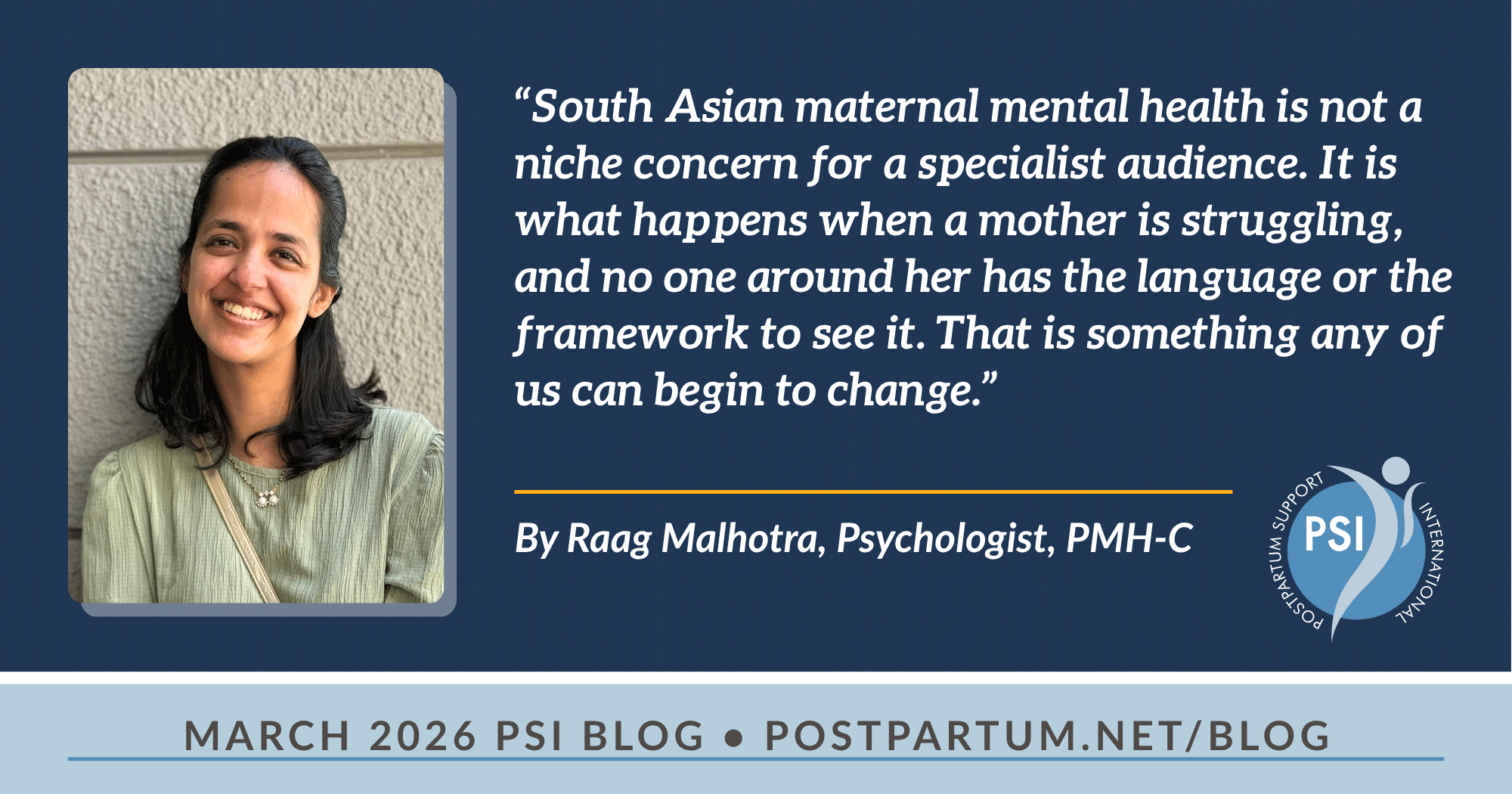
By Raag Malhotra, Psychologist, PMH-C
There’s a specific type of exhaustion that comes not simply from caring for a new child, however from carrying the burden of every thing you aren’t presupposed to say. For a lot of South Asian moms, whether or not residing in India, Pakistan, Bangladesh, Sri Lanka, or constructing a life removed from house, that weight is actual, and it accumulates quietly.
South Asian maternal psychological well being doesn’t exist in a vacuum. It’s formed by what households say and what they go away unsaid, by the hole between the reverence that motherhood is given in South Asian tradition and the assist that truly reveals up, and by a medical system that was largely designed for another person.
What the Analysis Truly Demonstrates
Perinatal temper and nervousness problems are a gaggle of situations that features postpartum melancholy, postpartum nervousness, and associated experiences, and are among the many most typical issues of being pregnant and the postpartum interval. They have an effect on moms no matter tradition, earnings, or how ready they felt moving into. Nonetheless, the burden will not be shared equally.
A 2026 systematic evaluation primarily based on 29 research discovered that almost one in three ladies in South Asian nations expertise perinatal melancholy, with a pooled prevalence of 28%, starting from 15% in Sri Lanka to 46% in Bangladesh (Morina et al., 2026). For South Asian moms who’ve migrated to high-income nations just like the US, UK, or Canada, the danger will increase additional. Throughout six research reviewed by Nilaweera et al. (2014), South Asian immigrant moms exhibited practically twice the danger of clinically important postpartum melancholy in comparison with ladies born in these nations, with odds ratios starting from 1.8 to 2.5.
“Near double: that’s the elevated danger of clinically important postpartum melancholy going through South Asian immigrant moms in comparison with their host-country-born counterparts (Nilaweera et al., 2014).”
But regardless of this elevated danger, these moms are among the many least more likely to entry skilled psychological well being assist. In a single giant research of Asian People with a recognized psychiatric dysfunction, solely 23% of foreign-born people had used psychological well being providers — in comparison with 41% of the overall inhabitants (Fancher et al., 2010). The hole between want and care will not be a matter of indifference. It’s a matter of boundaries which have by no means been adequately addressed.
The Silence Has a Form
In lots of South Asian households, changing into a mom comes loaded with expectation. There may be pleasure, sure, but in addition an unstated script about how a superb mom behaves, how a lot she provides, and the way little she asks for in return. When a mom finds herself struggling, not coping, not bonding, not feeling the best way she imagined she would, and the script doesn’t go away room for that.
Effectively-meaning responses from household can inadvertently shut off dialog: “All of us went by this.” “Consider your child.” “It is going to go.” These phrases are normally spoken with love, they usually land as dismissal. Analysis paperwork that concern of bringing disgrace to the household is without doubt one of the mostly cited causes South Asian moms don’t search skilled assist, significantly in diaspora communities within the UK and US (Fancher et al., 2010).
There may be one other layer that medical settings continuously miss. In South Asian populations, emotional misery is usually expressed by the physique, resembling persistent complications, fatigue, digestive issues, and again ache, somewhat than by the emotional language that Western screening instruments are designed to detect. This isn’t avoidance or denial. It displays a distinct, culturally grounded method of experiencing and speaking misery, documented constantly throughout analysis as somatisation (Fancher et al., 2010). When a supplier doesn’t recognise it, a mom in real want walks away undiagnosed.
The place the Scientific System Falls Brief
Western perinatal psychological well being care has developed genuinely efficient instruments — validated screening devices, evidence-based therapies, and pharmacological choices with sturdy security profiles. The issue will not be the instruments themselves. It’s the assumptions embedded in how and to whom they’re utilized.
Most Western therapeutic frameworks are constructed across the particular person: her emotions, her wants, her boundaries, her restoration. This sits awkwardly with South Asian cultural values which can be essentially collectivist — the place an individual’s id, selections, and sense of well-being are inseparable from household and group. A mom who doesn’t consider herself as a separate self navigating her personal therapeutic is not going to match neatly right into a mannequin that asks her to. Researchers who research how South Asian sufferers clarify and expertise psychological sickness have discovered this mismatch to be a major cause therapy both doesn’t begin or doesn’t proceed (Jain et al., 2025).
Structural boundaries pile on prime. Restricted entry to suppliers who converse related South Asian languages, the price of non-public remedy, and a scarcity of clinicians with any coaching in each perinatal psychological well being and cultural competence — for moms already stretched skinny, these are usually not small inconveniences. They’re the distinction between getting assist and never.
When South Asian sufferers deliver emotional misery to a major care doctor, it’s usually expressed by bodily signs. With out recognition, it goes untreated — and the mom goes house with no assist (Fancher et al., 2010).
What Households and Allies Can Truly Do
None of what follows requires a medical background. It requires paying consideration, staying within the room when issues get uncomfortable, and being keen to say one thing completely different from what has all the time been mentioned.
Cease minimising — even gently
The intuition to reassure is comprehensible. However “at the least the child is wholesome” and “your mom did this with no assist” each talk {that a} mom’s misery is proportionate to how a lot she has to complain about, which it’s not. When she shares one thing laborious, probably the most helpful response will not be a reframe. It’s staying with what she mentioned. Acknowledging it. Asking what she wants, somewhat than telling her what to really feel.
Reframe help-seeking as care — not weak spot
In lots of South Asian traditions, the postpartum interval already carries rituals of bodily care, relaxation, particular meals, and safety from overwork. That logic exists. It simply has not but been prolonged to emotional well being. Framing remedy or skilled assist as a part of that very same custom of tending to a brand new mom somewhat than as an admission of failure adjustments the dialog. Analysis on intergenerational household approaches inside South Asian communities means that bringing relations into the reframe, not simply the mom, is what makes it stick (Attaran et al., 2023).
Present up in concrete methods
Social isolation is without doubt one of the strongest and most constant predictors of postpartum psychological well being difficulties. For South Asian moms in diaspora communities, that isolation is usually acute; they’re removed from the prolonged household networks that in different circumstances would have surrounded them. Sensible presence issues. Bringing meals. Sitting with the child for a couple of hours. Texting with out expectation. Doing the small issues that say: you aren’t invisible, and you aren’t alone.
A Word for Clinicians
Suppliers working with South Asian moms carry specific accountability right here. When a clinician assumes a affected person shares their values about household roles, independence, or what it means to ask for assist, that assumption can finish therapy earlier than it begins. The analysis is direct on this level: suppliers’ lack of knowledge of South Asian cultural values is without doubt one of the major causes sufferers disengage from care (Fancher et al., 2010).
Culturally responsive apply means asking, not assuming: a few mom’s household construction, her immigration expertise, what feels acceptable to her group, and what assets really really feel accessible. It means recognising that household involvement in therapy will not be a complication; for a lot of South Asian moms, it’s a prerequisite. And it means treating the pursuit of cultural competence as an ongoing medical obligation, not an elective add-on.
The Silence Can Change
Nothing concerning the silence surrounding South Asian maternal psychological well being is mounted. It’s the product of particular situations, resembling cultural, medical, and structural, and these situations can change. However they not often change as a result of a mom lastly discovered the braveness to talk up alone. They modify as a result of the individuals round her stopped requiring that braveness to be a prerequisite for assist.
Households can have completely different conversations from those they inherited. Communities can construct peer assist that holds each cultural id and emotional honesty on the identical time. Suppliers can do the work of changing into genuinely helpful to moms whose lives don’t map onto a Western template. And allies or whoever is studying this may begin earlier than they’re requested.
South Asian maternal psychological well being will not be a distinct segment concern for a specialist viewers. It’s what occurs when a mom is struggling, and nobody round her has the language or the framework to see it. That’s one thing any of us can start to alter.
References
Attaran, S., Bhugra, D., & Bhui, Ok. (2023). Time to handle the psychological well being challenges of the South Asian diaspora. The Lancet Psychiatry, 10(6), 405–406. https://doi.org/10.1016/S2215-0366(23)00144-X
Fancher, T. L., Kravitz, R. L., & Fang, M. C. (2010). Psychological well being and stress amongst South Asians in america. Nationwide Institute on Minority Well being and Well being Disparities. https://pmc.ncbi.nlm.nih.gov/articles/PMC5643212/
Jain, R., Kakuma, R., Singla, D. R., Andresen, Ok., Bahkali, Ok., & Nadkarni, A. (2025). Explanatory fashions of widespread psychological problems amongst South Asians in high-income nations: A scientific evaluation. Transcultural Psychiatry, 62(1), 45–62. https://doi.org/10.1177/13634615241296302
Morina, A., Chowdhury, N., Hossain, T., Singh, P., & Rahman, M. (2026). Prevalence and danger elements of perinatal melancholy amongst ladies in South Asian nations: A scientific evaluation and meta-analysis. Journal of Affective Problems, 371, 214–226. https://doi.org/10.1016/j.jad.2025.09.017
Nilaweera, I., Doran, F., & Fisher, J. (2014). Prevalence, nature and determinants of postpartum psychological well being issues amongst ladies who’ve migrated from South Asian to high-income nations: A scientific evaluation of the proof. Journal of Affective Problems, 166, 213–226. https://doi.org/10.1016/j.jad.2014.05.011
In regards to the Creator

Raag Malhotra
Raag Malhotra is a PMH-C licensed perinatal psychological well being therapist supporting moms throughout two continents by remedy for shoppers in India and training for South Asian diaspora moms in america. She is a PSI Alliance fellow and serves in a number of volunteer management roles with Postpartum Assist Worldwide, together with as a PSI California DEI chair and board member. As a South Asian mom along with her personal lived expertise of perinatal sickness, Raag brings each medical depth and private understanding to her work. She creates assets for moms at @momsinnerjourney.
The views and opinions expressed on this weblog are these of the writer and don’t essentially replicate the official coverage, place, or views of PSI, its management, workers, associates, or companions. Any content material supplied by the writer is for informational functions solely and shouldn’t be construed as representing PSI’s official stance on any matter.
Discover these PSI Sources:
Asian, Pacific Islander, and Desi Moms Support Group
Connect with our Specialized Coordinator for South Asian Parents
Professional Trainings and Webinars
Subscribe to the PSI Blog

Join by PSI
Obtain our free app “Join by PSI” in your app retailer to entry PSI assist, assets, and data within the palm of your hand.


Trending Merchandise