
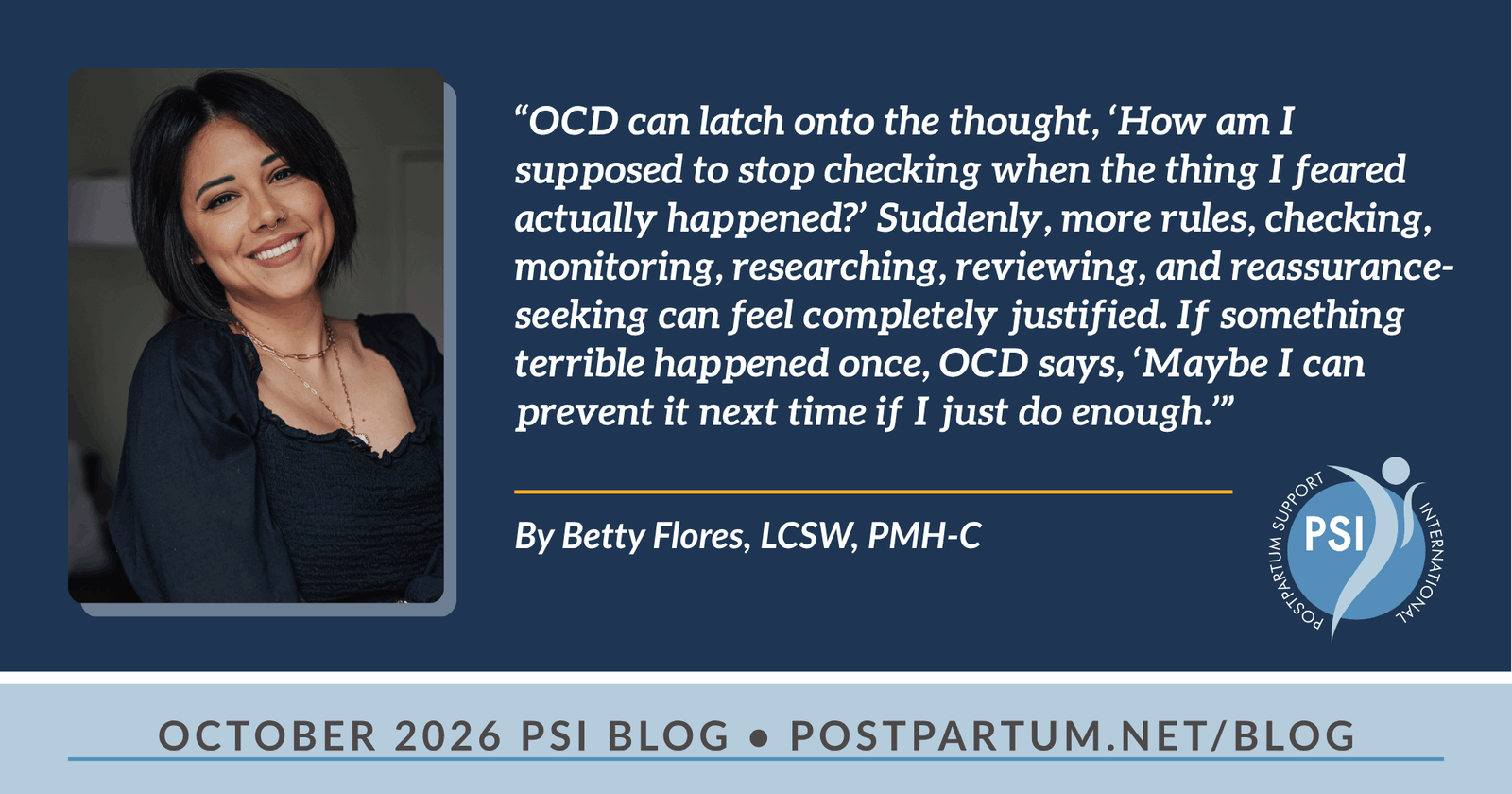
By Betty Flores, LCSW, PMH-C
Set off warning: intrusive ideas associated to being pregnant loss
OCD and trauma can look remarkably comparable throughout the perinatal interval. Understanding what drives the signs issues.
You lastly get pregnant after months or years of infertility, however as an alternative of feeling relieved, you might be ready for one thing to go improper.
You skilled being pregnant loss, and now each appointment or bodily sensation feels loaded with which means.
You survived a traumatic beginning, and returning to the hospital makes your total physique react.
Your child hung out within the NICU, and now you can’t cease watching their respiratory.
Or perhaps an intrusive picture instantly reveals your child being harmed. You examine, keep away from, or search reassurance since you desperately wish to know they’re protected.
From the skin, these experiences can look remarkably comparable, however trauma and OCD should not the identical factor. Typically they’ll coexist, which may make issues a bit extra complicated.
Why Trauma and OCD Often Overlap
For somebody who has skilled reproductive or perinatal trauma, it considerably modifications somebody’s relationship with security, uncertainty, and management.
Reproductive and perinatal trauma could contain, however should not restricted to, the next (additionally, simply because somebody experiences one of many following doesn’t imply they may develop Put up Traumatic Stress Dysfunction (PTSD)):
- Infertility and fertility remedy.
- Being pregnant loss.
- Stillbirth or toddler loss.
- Being pregnant issues.
- Traumatic beginning.
- Emergency medical interventions.
- NICU experiences.
- Surprising diagnoses.
- Earlier trauma resurfacing throughout being pregnant or postpartum.
As mentioned in my earlier article, SIDS, Pregnancy, and Infant Loss: Navigating Fear, Hypervigilance, and Grief, uncertainty can really feel very completely different after one thing devastating has already occurred.
The query can shift from, “May one thing occur?” to, “How do I MAKE SURE THIS NEVER HAPPENS AGAIN?”
What Can Trauma Signs appear like?
PTSD signs usually contain modifications in how somebody experiences reminiscences, reminders, feelings, and a way of security after trauma.
They embrace:
- Intrusive reminiscences or flashbacks associated to what occurred.
- Nightmares related to the traumatic expertise.
- Avoidance of individuals, locations, conversations, or reminders of the trauma.
- Hypervigilance, feeling continuously alert or anticipating hazard.
- Feeling simply startled or on edge.
- Modifications in ideas or feelings, together with guilt, disgrace, detachment, or problem feeling protected.
- Bodily reactions to reminders, equivalent to a racing coronary heart, rigidity, nausea, or panic.
Within the reproductive interval, a hospital, ultrasound, medical process, being pregnant milestone, another person’s being pregnant or toddler, or bodily sensation could turn out to be a trauma reminder.
That is the place PTSD and OCD can turn out to be tough to untangle.
What Occurs When Trauma and OCD Meet?
When trauma and OCD overlap, it may possibly turn out to be extremely tough to know what to belief.
Trauma could have already taught somebody that horrible issues can occur.
OCD can take that lived expertise and ask:
- What if it occurs once more?
- What if I miss the warning signal this time?
- What if I may stop it?
- What if I let my guard down and one thing occurs?
That is the place trauma and OCD can start feeding off each other.
By means of experiencing the trauma, the mind has proof that one thing painful actually did occur, and should enhance hypervigilance and sensitivity to perceived hazard.
OCD can latch onto the thought, “How am I presupposed to cease checking when the factor I feared truly occurred?” Abruptly, extra guidelines, checking, monitoring, researching, reviewing, and reassurance-seeking can really feel fully justified. If one thing horrible occurred as soon as, OCD says, “Perhaps I can stop it subsequent time if I simply do sufficient.”
Nonetheless, that is a kind of painful areas of life the place “sufficient” can’t assure certainty. No quantity of compulsive conduct can assure {that a} feared consequence is not going to occur.
It Can Additionally Make Analysis Extra Sophisticated
Analysis helps significant connections between OCD and PTSD signs throughout the perinatal interval. Read the study on PubMed
The overlap issues clinically as a result of each circumstances can contain:
- Hypervigilance.
- Intrusive experiences.
- Avoidance.
- Checking.
- Reassurance-seeking.
- Psychological reviewing.
- Makes an attempt to stop one other scary consequence.
A father or mother repeatedly checking their child’s respiratory may very well be responding to a trauma reminder. One other father or mother may very well be performing an OCD compulsion to acquire certainty. Somebody experiencing each won’t have the ability to simply separate the 2.
That’s what could make co-occurring OCD and trauma so tough.
The individual could also be attempting to course of one thing that really occurred whereas concurrently attempting to stop each attainable model of it from taking place once more.
Therapy can turn out to be difficult, too. As a result of, generally trauma has made OCD louder whereas OCD has made it more durable to maneuver by trauma.
Trauma work could require approaching reminiscences somebody desperately desires to keep away from.
Publicity Response Prevention (ERP) could require lowering the very checking or security behaviors which have helped them really feel protected.
That’s the reason a radical evaluation of the perform of the conduct turns into so vital.
How EMDR and ERP Can Be Mixed to Help Therapeutic
I’m licensed in each Eye Motion Desensitization Reprocessing (EMDR) and Publicity and Response Prevention (ERP), and I exploit each inside my scientific work. I’ve discovered that understanding the job of every intervention is particularly vital when trauma and OCD overlap.
EMDR is an evidence-based remedy for PTSD, and may also help us work with the traumatic expertise that occurred. ERP is an evidenced-based remedy for OCD that helps us work with OCD’s demand to know what’s going to occur subsequent, or try to stop one thing horrible from taking place once more.
I begin with OCD psychoeducation earlier than starting trauma reprocessing. The purpose is to assist somebody acknowledge their OCD cycle and the way it could present up throughout trauma work.
We establish intrusive obsessions and the compulsions used to cut back misery or achieve certainty. After trauma, these compulsions (checking, reassurance-seeking, researching, avoiding, or repeatedly reviewing what occurred) could give attention to attempting to know why it occurred or attempting to stop it from taking place once more.
This issues as a result of trauma reprocessing can generally turn out to be one other alternative for OCD to seek for solutions.
Somebody could start asking:
- Why precisely did this occur?
- What did I miss?
- May I’ve prevented it?
- What if I had finished one thing in a different way?
- How can I be sure that it by no means occurs once more?
As an alternative of processing the trauma, generally people can turn out to be caught ruminating, reviewing, or in search of reassurance in hopes of lastly feeling sure. That’s the place ERP ideas stay vital.
We apply noticing the urge to resolve or achieve certainty with out following it. That is known as response prevention in ERP: selecting to not carry out the compulsion OCD is asking for.
That may sound like:
- I want I may know this being pregnant might be completely different. I can’t have that assure.
- What occurred was painful. Extra worrying, replaying, or researching can’t give me certainty about what occurs subsequent.
- My mind desires certainty as a result of uncertainty has damage earlier than.
- I can honor what occurred with out reviewing it once more.
- That is tough to sit down with, and I can select to not examine.
These responses should not supposed to make worry or grief disappear. Nonetheless, they validate why uncertainty feels tough whereas serving to somebody step out of the compulsive cycle.
The purpose IS NOT to make use of EMDR to neutralize an obsession or lastly make somebody really feel sure.
That is the place I wish to discover:
Are we processing the expertise that occurred, or are we attempting to determine it out till uncertainty disappears?
For me, this distinction captures how EMDR and ERP can complement each other:
- EMDR processing creates area to work with what occurred.
- ERP helps somebody change their relationship with uncertainty about what may occur subsequent.
The Significance of Trauma-Knowledgeable, Proof-Based mostly Care: What Does the Analysis Say?
EMDR, Extended Publicity (PE), and Cognitive Processing Remedy (CPT) are evidence-based PTSD therapies.
Analysis particularly inspecting OCD and PTSD collectively remains to be creating. At present, PE + ERP have extra direct analysis supporting their mixed or sequenced use. Read more on PubMed
Accelerated Decision Remedy (ART) is one other rising trauma remedy with promising early analysis, though its proof base stays extra restricted.
For me, the analysis reinforces an vital scientific level: perceive what you might be treating and select interventions that match the perform of the signs.
Trauma-informed, evidence-based care validates why uncertainty feels so tough with out promising certainty we can’t present. We are able to acknowledge that the mind and physique realized one thing scary in regards to the world whereas recognizing when OCD calls for not possible certainty in regards to the future. Typically therapeutic means processing what did occur, working towards uncertainty round what may occur, or each. We are able to honor painful experiences with out spending our lives attempting to ensure the protection and certainty of what occurs subsequent.
Concerning the Writer

Betty Flores, LCSW, PMH-C
Betty Flores, LCSW, PMH-C, is a Licensed Perinatal Psychological Well being Therapist and proprietor of Perinatal Wellness LLC, a personal apply in Utah. She makes a speciality of perinatal OCD, being pregnant and toddler loss, being pregnant after loss, reproductive trauma, and perinatal psychological well being.
Betty gives evidence-based remedy, together with Publicity and Response Prevention (ERP) and EMDR, supporting people by being pregnant, postpartum, loss, and the uncertainty of being pregnant after loss. Learn More
The views and opinions expressed on this weblog are these of the writer and don’t essentially replicate the official coverage, place, or views of PSI, its management, workers, associates, or companions. Any content material supplied by the writer is for informational functions solely and shouldn’t be construed as representing PSI’s official stance on any matter.
Discover these PSI Assets:
Loss and Grief Resources
Get Help
Learn More About Perinatal Mental Health Disorders
Subscribe to the PSI Blog

Join by PSI
Obtain our free app “Join by PSI” in your app retailer to entry PSI assist, sources, and data within the palm of your hand.


Trending Merchandise