
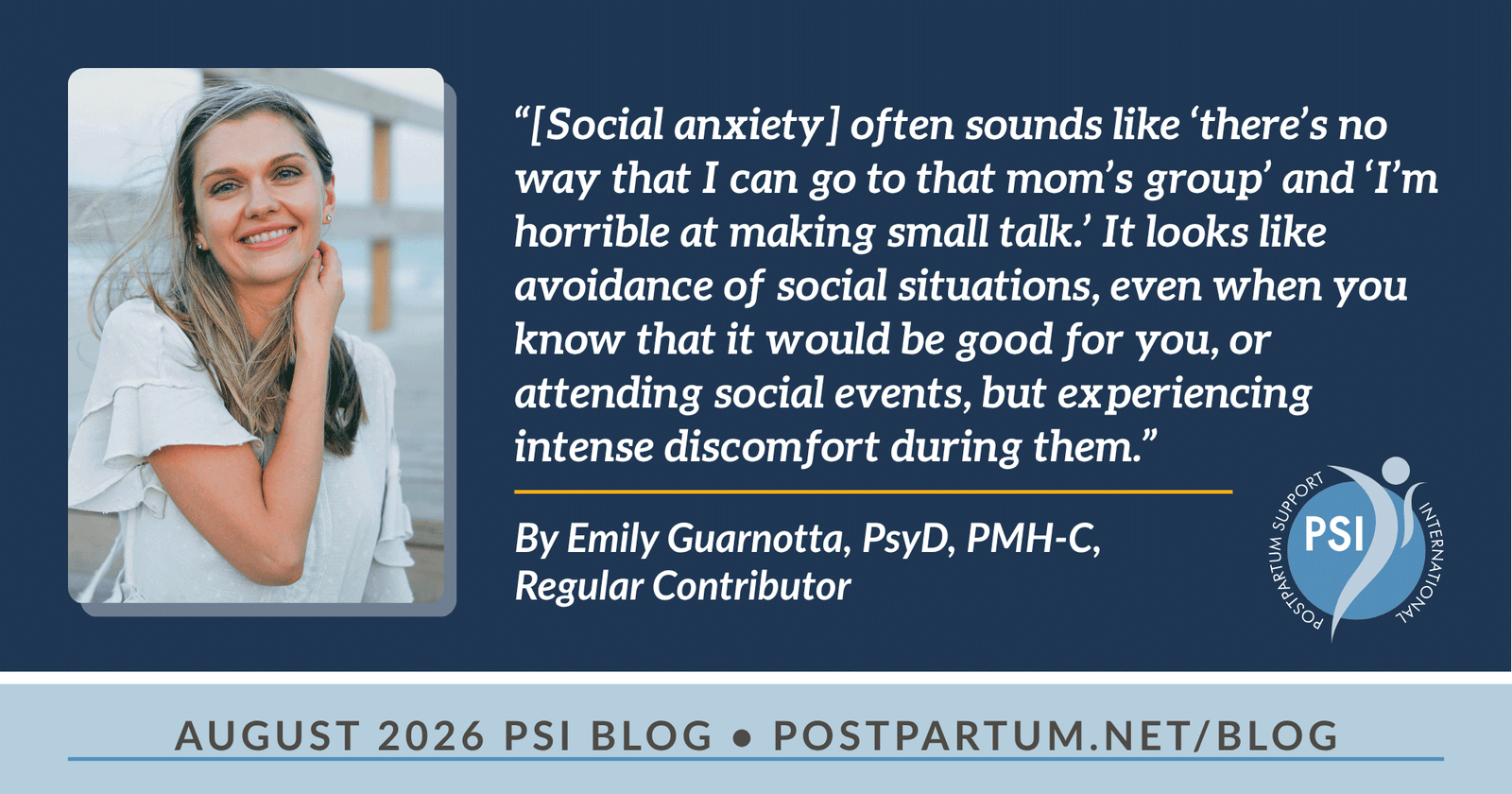
By Emily Guarnotta, PsyD, PMH-C, Common Contributor
Once you discover out that you simply’re anticipating a child, the cultural narratives promise a shared neighborhood. You may envision stroller walks with associates, members of the family coming over to satisfy the infant, and swapping tales at native parenting teams.
However for some new dad and mom, the fact can really feel a lot totally different. You may end up experiencing dread if you think about leaving the home or interacting with different folks, even these . Social nervousness is a kind of hysteria that entails a worry of being judged or embarrassed in social conditions, and it may be debilitating, particularly through the postpartum interval.
What Is Social Nervousness — And Why Being pregnant and Postpartum Amplify It
Within the psychological well being world, we discuss quite a bit about postpartum despair, however we are likely to glaze over postpartum nervousness. That is unlucky as a result of postpartum nervousness is the most typical perinatal psychological well being situation, affecting roughly 1 in 5 new moms.
Social nervousness is a kind of hysteria that’s extremely distressing and targeted round different folks. At its core, it’s a worry of social conditions pushed by an intense fear that you’ll be criticized or humiliated.
The perinatal interval, which incorporates being pregnant by means of the primary yr postpartum, is a time the place girls are extra weak to psychological well being situations like social nervousness. This is because of a variety of causes, together with important hormonal shifts, sleep deprivation and exhaustion, and identification adjustments.
When left untreated, social nervousness can result in isolation, despair, and negatively impression high quality of life. Fortuitously, social nervousness is treatable and many individuals who expertise it go on to recuperate and luxuriate in a superb high quality of life.
What Perinatal Social Nervousness Appears to be like Like
Social nervousness isn’t the identical as being a “little shy” or “introverted.” It’s an nervousness, or extreme fear, targeted on social conditions. In my work as a perinatal psychologist, it usually appears like “there’s no method that I can go to that mother’s group” and “I’m horrible at making small discuss.” It seems to be like avoidance of social conditions, even when that it will be good for you, or attending social occasions, however experiencing intense discomfort throughout them.
Listed here are some ways in which social nervousness can present up within the perinatal interval:
- Experiencing bodily sensations of panic, reminiscent of nausea, racing coronary heart, and sweating, when going right into a social state of affairs or having guests over
- Replaying conversations again and again in your head whereas pondering of all of the “unsuitable” stuff you stated
- Feeling insufficient and such as you’re simply “not good at” socializing
- Avoiding gatherings, playdates, and visits altogether
- Feeling afraid of feeding your child in public due to what others may assume or say
- Rehearsing what you’ll say again and again in social conditions
- Skipping physician’s appointments out of worry that you simply’ll be judged
- Feeling important reduction when plans get canceled
It must be famous that there’s a distinction between wanting to remain at residence with your personal little household, which is quite common, and even inspired through the postpartum interval in lots of cultures, and experiencing actual nervousness. Nervousness appears like worry and fear that may be very distressing. It’s uncomfortable and will persist and even worsen over time. In case you’re questioning if what you’re experiencing is perhaps nervousness, converse together with your physician or a therapist.
What You Can Do
Social nervousness isn’t one thing that you must simply reside with. If you end up feeling nervous in social conditions or avoiding them altogether, listed below are some locations you can begin:
Identify what you’re feeling. Labeling your nervousness as what it truly is, nervousness, reduces its energy. Telling your self “that is nervousness, not precise hazard” prompts the rational a part of your mind and may help interrupt the spiral.
Use the 5-4-3-2-1 grounding methodology. When bodily signs of panic spike, use this fast train to control your nervous system. Pause, take a deep breath, and title 5 issues you could see, 4 issues you’ll be able to really feel, 3 issues you’ll be able to hear, 2 issues you’ll be able to scent, and 1 factor you’ll be able to style. This easy train alerts to your mind that you’re secure and helps you’re feeling extra calm and relaxed.
Reframe your pondering. Social nervousness usually entails distorted ideas which may really feel actual to you, however aren’t essentially true. Recognizing this and selecting one other thought is a useful method. For instance, in case you worry that your child will cry in public and also you’ll be judged as a foul father or mother, attempt to remind your self that every one infants cry. Do not forget that crying is their type of communication, not a sign that you simply’re failing. It can be useful to keep in mind that you can’t learn different folks’s minds, so whilst you may assume that they’re judging you, you don’t know that for certain.
Search peer help. PSI’s free on-line help teams are a priceless useful resource to attach with different dad and mom who perceive precisely what you’re going by means of. It’s one place the place you don’t have to clarify your self. There are dozens of teams out there on-line every week for all sorts of fogeys, together with these experiencing nervousness, army households, and NICU dad and mom.
Discuss to knowledgeable. Therapy for social nervousness is obtainable and efficient. Therapy choices could embody remedy, medicine, or each. Cognitive Behavioral Remedy (CBT) is one sort of remedy that may make it easier to change the ideas which can be driving your worry and introduce you to methods to deal with them.
You Should Really feel Higher
If social nervousness is part of your story, you aren’t alone. It’s treatable and also you should get pleasure from parenthood with out fearing different folks or their opinions. If you’re struggling, please attain out for assist. Go to Postpartum Help Worldwide at postpartum.net to study extra, be a part of a free help group, or name the PSI HelpLine at 1-800-944-4773.
Sources:
- Postpartum Help Worldwide. Perinatal psychological well being: Indicators, signs, and therapy. https://www.postpartum.net/perinatal-mental-health/
- Leichsenring, F., & Leweke, F. (2017). Social nervousness dysfunction. New England Journal of Drugs, 376(23), 2255-2264. https://www.nejm.org/doi/abs/10.1056/NEJMcp1614701
- Suarez, G. L., Morales, S., Metcalf, Ok., & Pérez‐Edgar, Ok. E. (2019). Perinatal problems are related to social nervousness: Oblique results by means of temperament. Toddler and baby growth, 28(3), e2130. https://pmc.ncbi.nlm.nih.gov/articles/PMC7089570/pdf/nihms-1013300.pdf
- Loughnan, S. A., Wallace, M., Joubert, A. E., Haskelberg, H., Andrews, G., & Newby, J. M. (2018). A scientific assessment of psychological therapies for scientific nervousness through the perinatal interval. Archives of ladies’s psychological well being, 21(5), 481-490. https://www.proquest.com/openview/4dbcaea107fac0a59a98b687912c8df8/1?pq-origsite=gscholar&cbl=32254
In regards to the Creator

Emily Guarnotta, PsyD, PMH-C
Emily is a licensed scientific psychologist and PMH-C. She focuses on maternal psychological well being and substance use issues, offering look after purchasers going through infertility, being pregnant loss, and perinatal temper and nervousness issues. She is among the founders of Phoenix Health, an internet follow targeted on perinatal psychological well being. Dr. Guarnotta is devoted to elevating consciousness and enhancing entry to psychological well being companies for households adjusting to parenthood.
The views and opinions expressed on this weblog are these of the creator and don’t essentially replicate the official coverage, place, or views of PSI, its management, staff, associates, or companions. Any content material offered by the creator is for informational functions solely and shouldn’t be construed as representing PSI’s official stance on any matter.
Discover these PSI Sources:
Free Online Peer Support Groups
Postpartum Planning Class
Provider Directory
Subscribe to the PSI Blog

Join by PSI
Obtain our free app “Join by PSI” in your app retailer to entry PSI help, sources, and data within the palm of your hand.


Trending Merchandise